Journalscope vs Caseware IDEA for audit journal entry testing
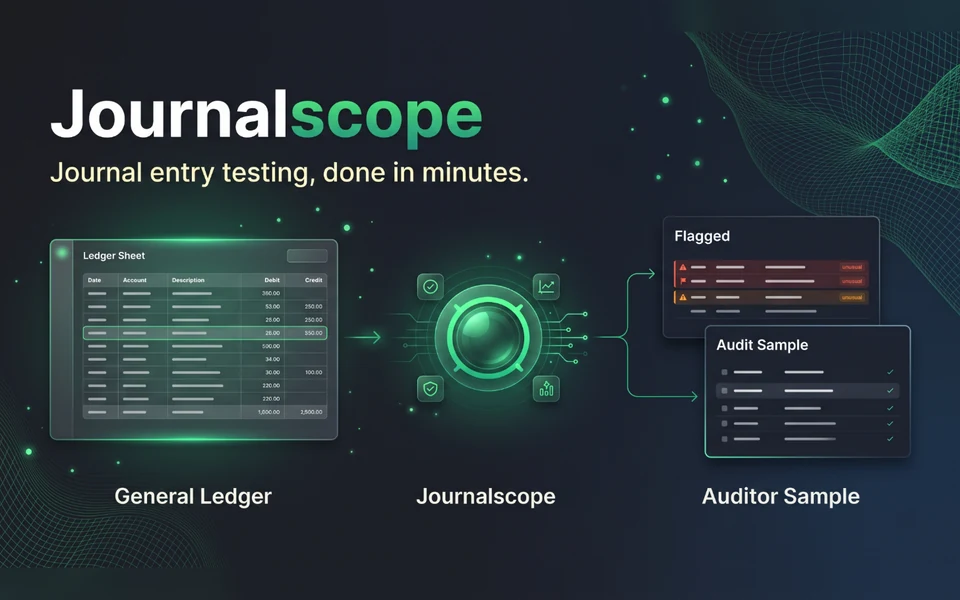
If your audit team is comparing Journalscope and Caseware IDEA, start with the work you need to complete. Journalscope focuses on journal entry testing: checking the population, applying risk criteria, selecting journals and exporting an Excel workpaper. IDEA is a broader audit analytics product.
For an audit partner or manager at a small or midsize firm, the decision depends on how much of that broader environment the team uses. A focused journal testing tool may fit an immediate engagement need. An established analytics workflow may justify keeping IDEA.
Atesen Software makes Journalscope, so this comparison comes from one of the two vendors. Statements about IDEA come from Caseware's own pages, which we re-opened on 29 October 2026.
Compare the workflow you will actually use
| Decision | Journalscope | Caseware IDEA |
|---|---|---|
| Main scope | Journal population checks, risk criteria, selection and workpaper | Broader audit data analysis |
| Starting point | Open CSV or XLSX files in your browser | Import client files into an IDEA project |
| Repeatability | Recorded settings, file SHA-256 fingerprints and a selection seed | Re-runnable routines; scripts can be scheduled |
| Output | Excel journal testing workpaper and flagged journal CSV, both with a licence | Outputs that can be published to teams and clients |
| Price | Firm licence: US$790 for 12 months, up to 5 auditors | check current pricing |
Caseware describes IDEA's project workflow, re-runnable routines and publishing of outputs on its IDEA product page. The differences above describe scope; they do not establish that one product produces better audit evidence.
Open the ledger locally and check the mapping
Journalscope reads the ledger and trial balance inside your browser tab. Those files are not uploaded to Atesen Software, and closing the tab discards them. The workpaper is also generated in the browser and saved to your computer. The privacy policy separates that processing from normal website requests and payment records.
You open a CSV or XLSX export and review the suggested column mappings. Journalscope recognises common column names from systems including Xero, QuickBooks and Sage, and you can override every guess. These are file mapping aids, not direct connections to those accounting systems.
IDEA also has a desktop workflow. Caseware documents launching an installed IDEA project from Working Papers, with IDEA installed on the same workstation. A preference for local processing alone is therefore not a reason to reject IDEA. Compare the exact configuration your firm would use. See Caseware's guidance on launching IDEA from Working Papers.
Review completeness before relying on the selection
With a trial balance that includes opening balances, Journalscope checks opening balance plus ledger movement against closing balance for each trial balance account. It lists differences alongside journal numbering gaps, lines outside the selected period and rows it could not read. It also reports whether total debits and credits agree.
The trial balance matters. Running journal criteria without it does not perform the trial balance reconciliation. Your team must investigate exceptions and assess whether the supplied files represent the population it intends to test.
Journalscope includes 19 risk criteria. Examples include weekend postings, round amounts, seldom posting users, possible duplicates and entries recorded after period end but dated within the period. The public holiday test uses the England and Wales, Ireland or US federal calendar that you choose, or none. Applicability depends on the fields available and the settings you choose. An export missing an approver cannot support the same checks as an export containing that information.
Give the reviewer the selection parameters
Journalscope combines selection by risk score with a seeded random element. With the same input files, mappings and settings, including the seed, it selects the same journals.
The licensed Excel workpaper contains nine sheets. These include completeness, criteria, flagged journals, the sample and the sample's underlying lines. It records file SHA-256 fingerprints and selection parameters. The sample sheet has columns for evidence inspected, whether the journal was authorised, business rationale, whether it is an exception and a workpaper reference.
This is useful when your team wants to continue its testing in Excel and retain the workbook in the engagement file. You still obtain supporting evidence and reach the conclusion. A flag identifies a characteristic for investigation; it does not establish fraud.
Compare licence scope before comparing cost
Journalscope's Firm plan costs US$790 for up to 5 auditors. Practice costs US$1,490 for up to 25 auditors. Network costs US$2,900 for unlimited auditors within the firm and its offices.
Each payment covers 12 months of export access and unlimited engagements. Licences do not renew automatically, and a full refund is available within 14 days. Loading files and viewing results on screen is free; Excel workpaper and CSV exports require a licence. See the licence terms.
For Caseware IDEA, check current pricing. Compare the proposed licence with your firm's existing entitlements and actual analytics requirements. This comparison does not claim Journalscope is cheaper than your particular IDEA arrangement.
When keeping IDEA makes sense
If your team already uses IDEA routines across engagements, assess what a change would interrupt. IDEA's wider import, automation and reporting capabilities may serve work beyond journal testing. Journalscope is a narrower choice for teams seeking the documented journal testing workflow.
Questions
Can Journalscope replace the entire audit file?
No. Journalscope produces a journal testing workpaper. Your firm retains responsibility for its wider methodology, engagement documentation and conclusions.
Can we evaluate it before buying?
Yes. Start with the fictional sample, then assess an export you are authorised to use. Inspect the mappings, completeness exceptions and selection reasons on screen before choosing a licence.
Try Journalscope with a ledger you understand
Try Journalscope's free sample and inspect the results against your team's requirements, or see Journalscope's plans.
Try the free sample See plans and buy
Use code FOUNDING40 at checkout for 40% off your first payment until 30 Nov 2026.
Related guides: Caseware IDEA alternatives for audit journal testing · Dorafile vs Copla Registry for your DORA register · Tinfile vs TRSuite: CRS and FATCA XML compared. All guides.
More about the product: Journalscope on Atesen Software.
Published by Atesen Software, which makes Journalscope. Caseware and IDEA are trademarks of their owner; this page is not affiliated with, sponsored or endorsed by Caseware.