Tidyroll versus MERGEguard
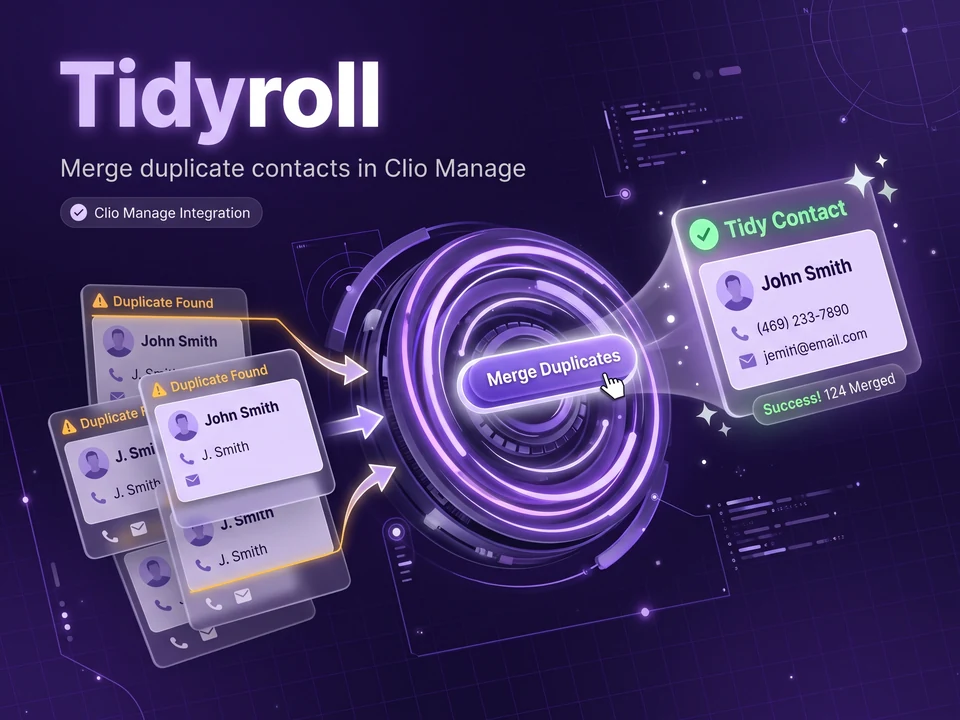
Tidyroll and MERGEguard both help law firms find duplicate contacts in Clio Manage. For a firm administrator choosing between them, the useful questions concern what happens after detection: which records can move, how you approve changes, what recovery involves, and what you pay.
Check this first: Tidyroll works only with Clio Manage accounts in Clio's US region (app.clio.com) today. The Canada, Europe/UK and Australia regions are not open yet, and Clio Grow is not supported. Your Clio plan also needs apps and integrations. If your firm is outside the US region, Tidyroll cannot connect to your account yet.
Tidyroll combines duplicate cleanup with bulk contact editing. Its paid plans are on sale: the Cleanup Pass costs $199 for 90 days on one Clio account, and Monitor costs $29 per month. MERGEguard sells cleanup engagements priced by contact volume. Both offer a free scan, so you can investigate before buying.
Atesen Software makes Tidyroll, so this page is not a neutral review. It reflects Tidyroll's own site and code, and MERGEguard's public pages as we read them on 29 October 2026.
Compare the cleanup scope before the price
| Decision | Tidyroll | MERGEguard |
|---|---|---|
| Initial assessment | Free duplicate and data health counts, plus three sample groups; read only, no card | Free scan, read only, no card, per its pricing page |
| Cleanup purchase | $199 once; 90 days; one Clio account | Contact volume tiers for a one-time, three month cleanup |
| Approval | Choose the surviving contact and field values; preview; typed confirmation | Choose which contact to keep, merge or skip in each group; explicit confirmation for every merge |
| Recovery | Undo journaled changes for 30 days; later Clio edits are left alone | Homepage describes merges as not undoable; security page describes a pre-merge snapshot (see below) |
| Ongoing option | Monitor at $29/month | Optional monitoring at $99/month |
On its homepage, MERGEguard says merges cannot be undone once they run in Clio. Its security page describes a best-effort snapshot taken before a duplicate is removed, presented as an audit record rather than a complete backup, which supports manual re-creation of the removed record's core data. Confirm the recovery process with the vendor before relying on it. Sources: MERGEguard homepage and MERGEguard security page, checked on 29 October 2026.
Tidyroll gives you field choices and a change preview
Tidyroll looks for likely duplicates using email, normalized phone numbers, names, company names and addresses. Each suggested group includes the reasons it matched. A shared office phone or generic mailbox is treated as weak evidence; a suggested match still needs your judgment.
You choose the contact to keep and review the planned field values and linked record changes. You then type a confirmation such as MERGE 1. Tidyroll does not automatically merge contacts.
Supported changes include reassignment of matters, relationships, communications and documents filed directly on a contact. Notes are copied with information identifying their original author and dates. The duplicate contact remains in Clio, keeps its name, and receives a note identifying the surviving record.
That retained record matters when setting expectations: a Tidyroll merge consolidates supported information without deleting the duplicate contact.
Undo has a time window and clear limits
Tidyroll records changes for undo for 30 days. If someone subsequently changes a record in Clio, undo leaves that later edit alone. Treat this as a recovery option with limits, rather than a guarantee that every future account state can be restored.
The merge planner also blocks cases it cannot handle safely. Examples include bills, trust or bank transactions, credit memos, Clio Payments, nonzero balances, client portal access and co-counsel access on the duplicate. A duplicate that is an attendee on a calendar entry also blocks a merge; Tidyroll does not move calendar attendees. A person cannot be merged into a company.
Incomplete safety checks can prevent merging too. Firms with more than 100,000 expense entries, or more than 25 contact-type custom fields, cannot be checked completely, so their merges stay blocked. A free scan identifies likely duplicates, but it does not run these merge eligibility checks. Those happen when a merge plan is prepared. Finding a group therefore does not guarantee that Tidyroll can consolidate it.
Clio allows about 50 API requests per minute per user during business hours, so 100 merges can take an hour or more. Tidyroll runs jobs in the background.
Pricing separates a cleanup project from recurring work
Tidyroll's Cleanup Pass includes unlimited merges within its supported scope, bulk editing, the full duplicate list and CSV exports for one Clio account over 90 days. Monitor costs $29/month and includes a weekly re-scan, a counts only email digest, bulk editing and an allowance of 50 merged duplicate contacts per calendar month. Prices are in USD; Paddle, the merchant of record, adds sales tax or VAT where it applies and shows it at checkout. These prices match the Tidyroll pricing page as read on 29 October 2026.
MERGEguard lists $1,750 for up to 5,000 contacts, $3,500 for up to 25,000 and $6,000 for 25,001 or more, with custom volume priced on request, as listed on 29 October 2026. Its optional monitoring is listed at $99/month after the engagement. Check current pricing before purchasing. MERGEguard pricing.
The lower Tidyroll entry price does not establish equivalent coverage. Compare the contacts you need to clean and the handling of exceptions. Tidyroll scans are currently limited to 30,000 contacts, and a bulk edit job is limited to 5,000 contacts.
Choose around your firm's actual cleanup work
Tidyroll is worth evaluating if your firm uses Clio Manage in the US region, wants to review duplicates itself, edit contact fields in bulk, and retain a defined undo window. Bulk editing supports filtering contacts and setting, clearing, replacing or trimming supported values, with a preview and the same undo.
MERGEguard is worth evaluating if its volume based engagement and documented workflow suit your firm. Ask the vendor directly about recovery, supported Clio regions and your linked record requirements. Neither a comparison table nor a low price replaces that assessment.
Questions before you choose
Questions
Does Tidyroll work outside the United States?
Not yet. Tidyroll connects only to Clio Manage accounts in Clio's US region today. The Canada, Europe/UK and Australia regions are not open yet.
Does a Tidyroll merge delete the duplicate contact?
No. The duplicate contact stays in Clio with its name unchanged and a note identifying the surviving record. Supported linked records move to the surviving contact, and undo is available for 30 days.
Is the free scan really free?
Yes. The scan is read only and needs no payment card. It shows duplicate and data health counts and three sample duplicate groups. It does not run the merge eligibility checks.
Try it on your own contacts
Run a free Tidyroll scan: you sign in with Clio on its own page, and the scan reads your contacts without changing them. When you are ready to clean up, see Tidyroll pricing for the Cleanup Pass and Monitor.
Run a free scan See plans and buy
Use code FOUNDING40 at checkout for 40% off your first payment until 30 Nov 2026.
Related guides: MERGEguard alternatives for law firm administrators · Payoutfold vs A2X: payout CSV or connected sync? · Fillwarden vs Conveyor: security questionnaire tools. All guides.
More about the product: Tidyroll on Atesen Software.
Published by Atesen Software, which makes Tidyroll. MERGEguard is a trademark of its owner; this page is not affiliated with, sponsored or endorsed by MERGEguard. Clio is a trademark of Themis Solutions Inc.; Tidyroll is an independent product by Atesen Software and is not affiliated with, sponsored or endorsed by Clio.