EU fragrance allergen labelling: which allergens go on the label
Under the EU Cosmetics Regulation, a fragrance allergen listed in Annex III must be named in the ingredient list when it is above 0.001% of a leave-on product or 0.01% of a rinse-off product. You work it out from your fragrance oil supplier's allergen table: the amount in the oil times the oil in the product.
Have the supplier's allergen table at hand? Paste it into Scenttag free
Work it out by hand What it does not cover
The rule in short
- The law. Regulation (EC) No 1223/2009 on cosmetic products, Annex III. Commission Regulation (EU) 2023/1545 of 26 July 2023 amended it "as regards labelling of fragrance allergens in cosmetic products"; the Commission lists both on its cosmetics legislation page.
- The thresholds. An allergen is named in the ingredient list above 0.001% in a leave-on product, such as a lotion, balm or perfume, and above 0.01% in a rinse-off product, such as soap, shampoo or shower gel.
- The longer list. The 2023 amendment added many more fragrance allergens to the ones that must be named. Products that did not comply could still be placed on the EU market until 31 July 2026 and made available until 31 July 2028.
- The percentage is of the finished product. Not of the fragrance oil. A supplier's table gives the allergens as a share of the oil, so you scale it by how much oil you use.
How to work out which allergens go on the label
- Get the allergen table. Ask your fragrance oil supplier for the allergen declaration of the oil, with each allergen as a percentage of the oil, listed against the current EU list.
- Decide leave-on or rinse-off. Soap and shower gel are rinsed off; lotion, balm and solid perfume stay on the skin. The threshold follows from this.
- Scale each allergen. Percentage in the product = percentage in the oil × percentage of oil in the product ÷ 100.
- Add rows that share an entry. Where two rows of the table fall under the same Annex III entry, add them up before you compare.
- Compare and list. Every allergen above the threshold goes in the ingredient list by its name in the regulation. Repeat for each oil and add them up when a product uses several.
A worked example. The oil holds 5% linalool and 0.02% of another allergen, and you use 3% oil. Linalool is 5 × 3 ÷ 100 = 0.15% of the product, above both thresholds, so it is listed on a lotion and on a soap. The other allergen is 0.02 × 3 ÷ 100 = 0.0006%, below 0.001%, so it is not listed even on a lotion.
Where doing it by hand gets hard
- Long tables. With the longer list, a supplier's declaration can run to dozens of rows per oil, each scaled and compared.
- Several oils in one product. A blend of three oils means the same allergen can come from each of them, and the amounts are added before the threshold check.
- Names that differ. Suppliers do not always use the exact name of the regulation, so each row has to be matched to the right entry.
- A new batch, a new sum. Change the oil percentage or the supplier and every figure changes.
Labelling is one part of selling a cosmetic in the EU. The label is confirmed by your Responsible Person or safety assessor as part of the cosmetic product safety report (CPSR).
Option: Scenttag
Disclosure. Atesen Software, which publishes this guide, makes Scenttag. The steps above work without it.
- Paste the table. Paste the allergen table from your fragrance oil supplier, or try the sample on the page. The names are matched to the official EU allergen list.
- Enter the product. The product type, leave-on or rinse-off, and how much oil is in the product.
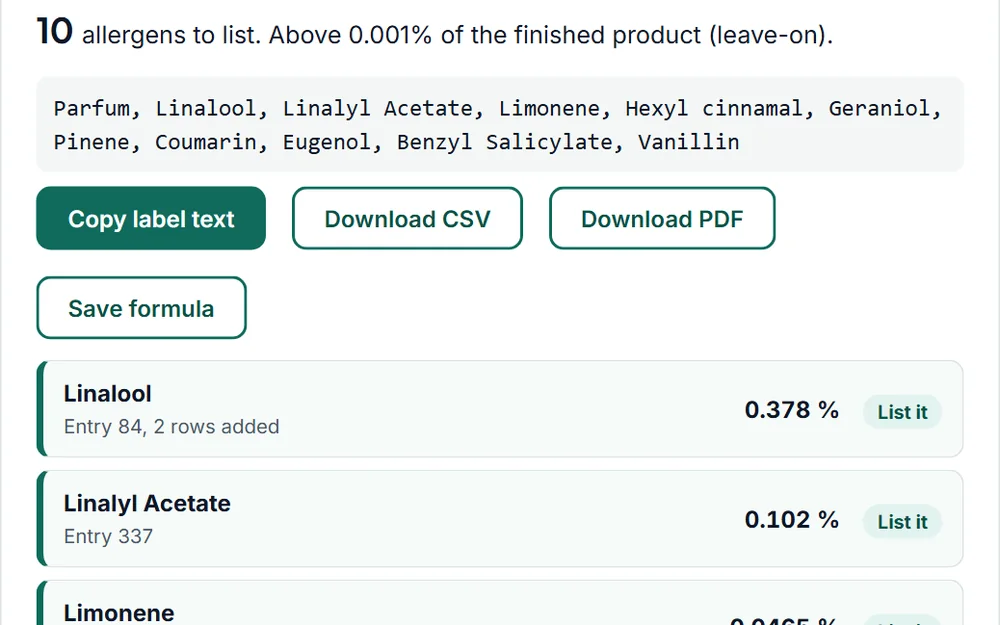
- Read the result. Each allergen is worked out as the amount in the oil times the oil in the product, divided by 100, and rows under the same Annex III entry are added up. You get the allergens that go on the label and the label text to copy.
Your data. The table, the oil names and the percentages are handled in the page and are not uploaded. Saved formulas are kept in your browser, and clearing site data removes them.
Limits. Scenttag gives information, not legal advice or a safety assessment, and it does not replace a CPSR. It does not check maximum use limits and does not file or notify anything. It covers EU rules only; Great Britain keeps its own list. Candles and wax melts are outside it, because it covers cosmetic products applied to the body.
Price. The full result for one fragrance oil is free, with the label text to copy. The monthly plan is $9 a month, cancel any time: it combines several oils in one formula, saves formulas in your browser and downloads PDF and CSV files. Prices are in US dollars; local VAT or GST is included or added at checkout by Paddle.
Which route fits
- One oil, a short table: the five steps above and a calculator.
- Several oils, frequent new batches or many products: a tool such as Scenttag, then a check by your safety assessor.
- Selling in Great Britain as well: check the GB list separately; it is not the same as the EU one.
More guides on rules that sit behind a product label or a filing: EPR packaging reporting requirements in California, Colorado and Oregon. All of our guides are on the guides page.
Atesen Software is independent. Scenttag is independent and not affiliated with or endorsed by the European Commission, IFRA or any fragrance supplier. This page is information, not legal advice. The Commission's legislation page was checked on 15 November 2026.
Questions about this guide: support@atesensoftware.com.
Questions people ask
When does a fragrance allergen have to be on the label in the EU?
When it is above 0.001% of a leave-on product or above 0.01% of a rinse-off product, measured in the finished product, not in the fragrance oil.
How do I calculate the allergen percentage in my soap?
Multiply the allergen's percentage in the oil by the percentage of oil in the soap and divide by 100. Soap is rinse-off, so the allergen is listed above 0.01%.
Is it still only the 26 allergens?
No. Regulation (EU) 2023/1545 added many more fragrance allergens to the ones that must be named. Products that did not comply could be placed on the EU market until 31 July 2026 and made available until 31 July 2028.
Do candles need fragrance allergen labelling under these rules?
Not under the Cosmetics Regulation, which covers cosmetic products applied to the body; candles and wax melts follow other EU chemical labelling rules. They are outside Scenttag for that reason.
Is Scenttag free?
The full result for one fragrance oil is free, with the label text to copy. The monthly plan is $9 a month and adds several oils in one formula, saved formulas and PDF and CSV downloads.