Too many lead status unknown service lines in our inventory: what now?
Under the LCRI, a lead status unknown line costs you almost as much as a lead line until you resolve it. It goes into the replacement pool with lead and galvanized requiring replacement lines. That raises the 10% a year you must replace. Every customer it serves gets a notification within 30 days of the baseline inventory, due 1 November 2027, and again after each annual update (40 CFR 141.84, 141.85(e)). Unknowns found to be non-lead come out of the pool at the annual update. Start with the ones that are cheapest to prove: lines installed after your lead ban year, and lines wider than 2 inches.
Count your unknowns free, no sign-up Which unknowns to resolve first
Linewarden is web software by Atesen Software, the publisher of this guide. It reads the inventory spreadsheet you already have, in your browser. It is independent of EPA and is not legal or engineering advice.
What an unknown line does to your numbers
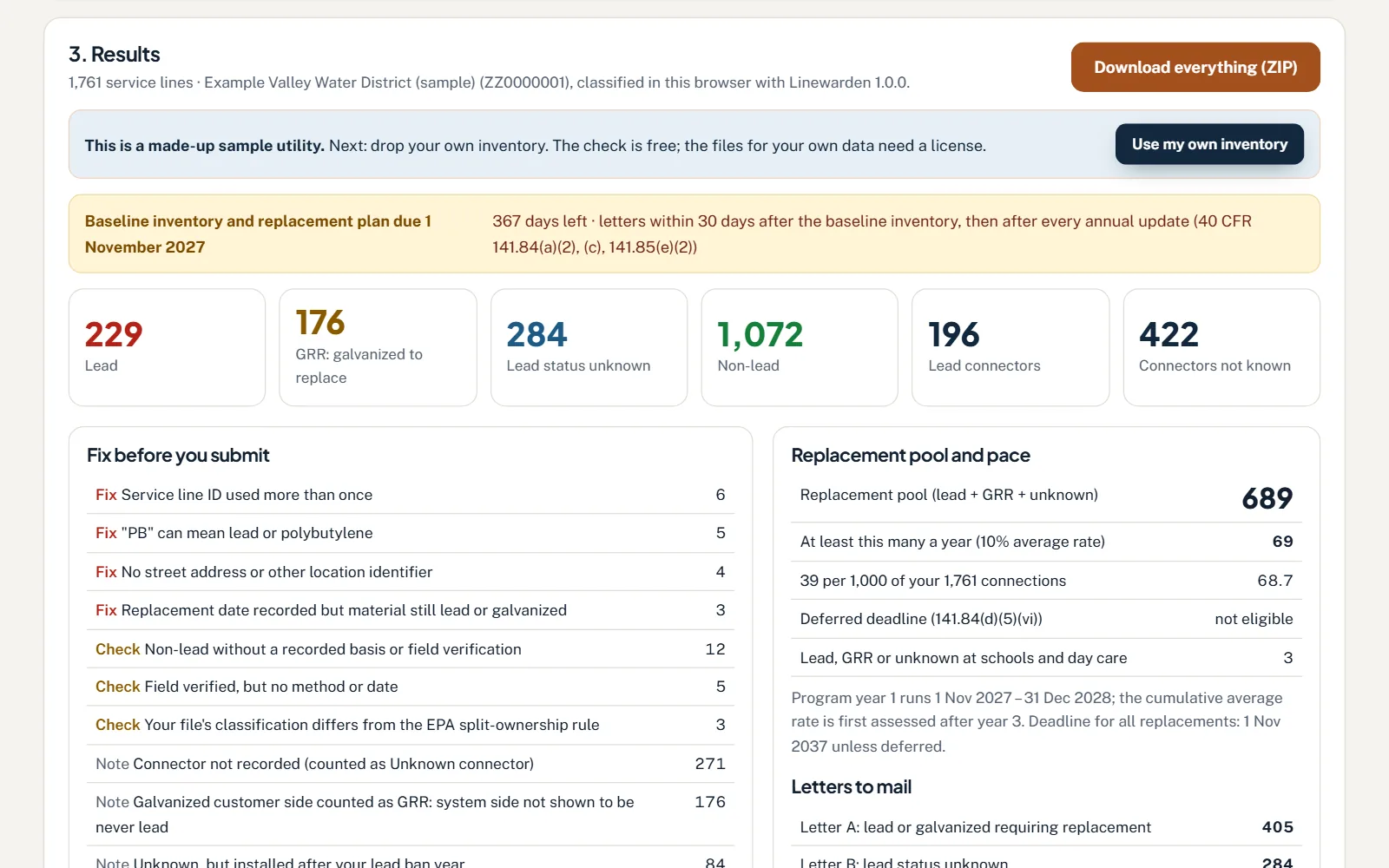
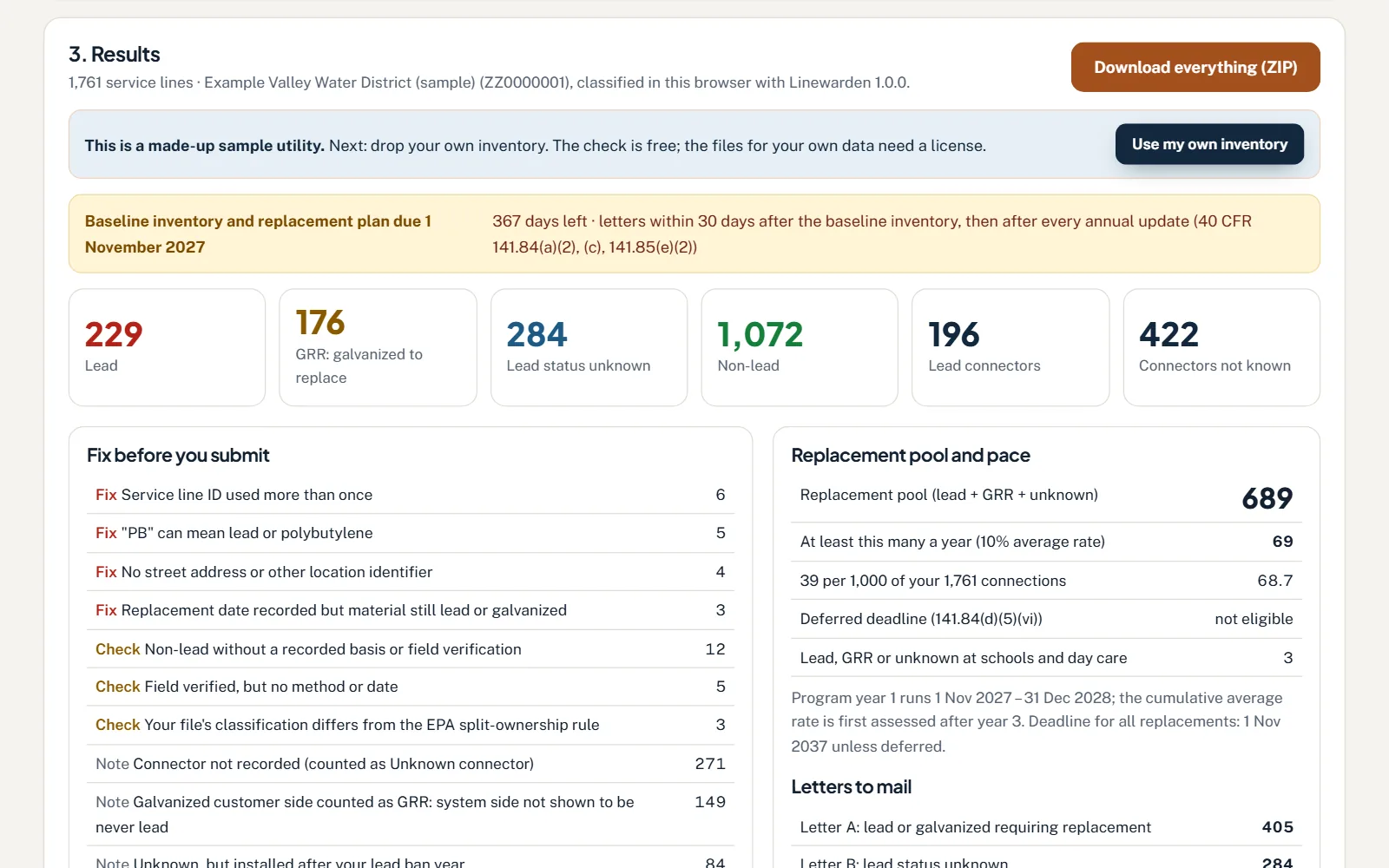
In Linewarden's made-up sample utility, 1,761 service lines classify as 229 lead, 176 galvanized requiring replacement, 284 lead status unknown and 1,072 non-lead.
| With 284 unknowns | If all 284 were proven non-lead | |
|---|---|---|
| Replacement pool (lead + GRR + unknown) | 689 | 405 |
| At least this many a year (10% average) | 69 | 41 |
| Customer letters after the baseline | 405 lead/GRR + 284 unknown | 405 |
The pool is set from the baseline inventory, and unknowns found to be non-lead come out at the annual update. So every unknown resolved before 1 November 2027 is one less line in the pool and one less letter.
Which unknowns to resolve first
| What your records show | Why it may be quick to resolve | What the non-lead call needs |
|---|---|---|
| Installed after your lead ban year | Lead pipe should not have been installed then | The installation date on record; a lead ban basis is only valid for a date after the ban |
| Wider than 2 inches | Candidate for the methods your State accepts | The recorded basis your State accepts for that method |
| Material known on one side, unknown on the other | Only one side to identify | Evidence for the unknown side; unknown plus non-lead stays Unknown |
| Field visit done, result recorded as non-lead | Already checked | The method and the date of the field verification |
| No records at all | Not quick | An identification method your State accepts |
Every non-lead call needs a recorded basis. A "non-lead" with no basis or no verification method and date is the kind of row a State reviewer questions. In the sample, 84 unknown lines were installed after the lead ban year: the first ones to check.
Count and sort your unknowns in one pass: Linewarden
Linewarden applies EPA's entire-line rule to every row, so unknown plus non-lead stays Unknown. It lists the unknowns installed after your ban year or wider than 2 inches as candidates, flags non-lead calls with no recorded basis or no verification method and date, and counts the replacement pool and the yearly pace. It also writes both letters: one for lead and GRR, one for lead status unknown. It does not inspect lines or write the plan narrative.
- Free: the sample, and your own file's counts, problems and first 25 lines on screen, without sign-up.
- Single system: $990 for 12 months, one water system. With code FOUNDING40 until 30 November 2026: $594.
- Multi-system: $1,990 for up to 10 systems ($1,194 with FOUNDING40). Consultant: $3,900, unlimited client systems ($2,340 with FOUNDING40).
- Refund: if Linewarden does not work for your inventory, a full refund within 14 days of purchase (refund policy). Purchase orders: procurement page.
Get a license ($594 with FOUNDING40) Or check the free sample first
Prices from Linewarden pricing, checked 16 November 2026.
Questions people ask
Do lead status unknown lines count toward LCRI replacement?
Yes. The replacement pool counts lead, galvanized requiring replacement and lead status unknown lines in the baseline inventory. Unknowns found to be non-lead come out of the pool at the annual update.
Do customers with an unknown service line get a letter?
Yes. Every customer served by a lead, GRR or lead status unknown line gets the required notification within 30 days of the inventory, and again after each annual update (40 CFR 141.85(e)).
How do I prove an unknown service line is non-lead?
With a recorded basis your State accepts: records, an installation date after your lead ban year, or a field verification with its method and date. Each non-lead call should carry its basis in the inventory.
Is unknown plus non-lead classified as non-lead?
No. Under EPA's entire-line rule, a line with one non-lead side and one unknown side stays lead status unknown until the unknown side is identified.
When is the LCRI baseline inventory due?
By 1 November 2027 for community and non-transient non-community water systems, with the replacement plan and a public inventory (40 CFR 141.84).
Sources: 40 CFR 141.2, 141.84 and 141.85(e) (eCFR); Federal Register 2024-23549 (89 FR 86418); EPA: Lead and Copper Rule Improvements. Checked 16 November 2026. A court challenge to the LCRI is pending; the inventory and notification duties of the earlier Lead and Copper Rule Revisions continue in any case.
More: is a galvanized line GRR?, LCRI service line inventory checklist, Linewarden in our catalogue.
Linewarden is independent software. It is not affiliated with or endorsed by the U.S. EPA or any State drinking water program, it does not replace your State's review, and this page is not legal or engineering advice.
Questions about this guide: support@atesensoftware.com.